Empirical Insights into Coastal Governance & Climate Resilience
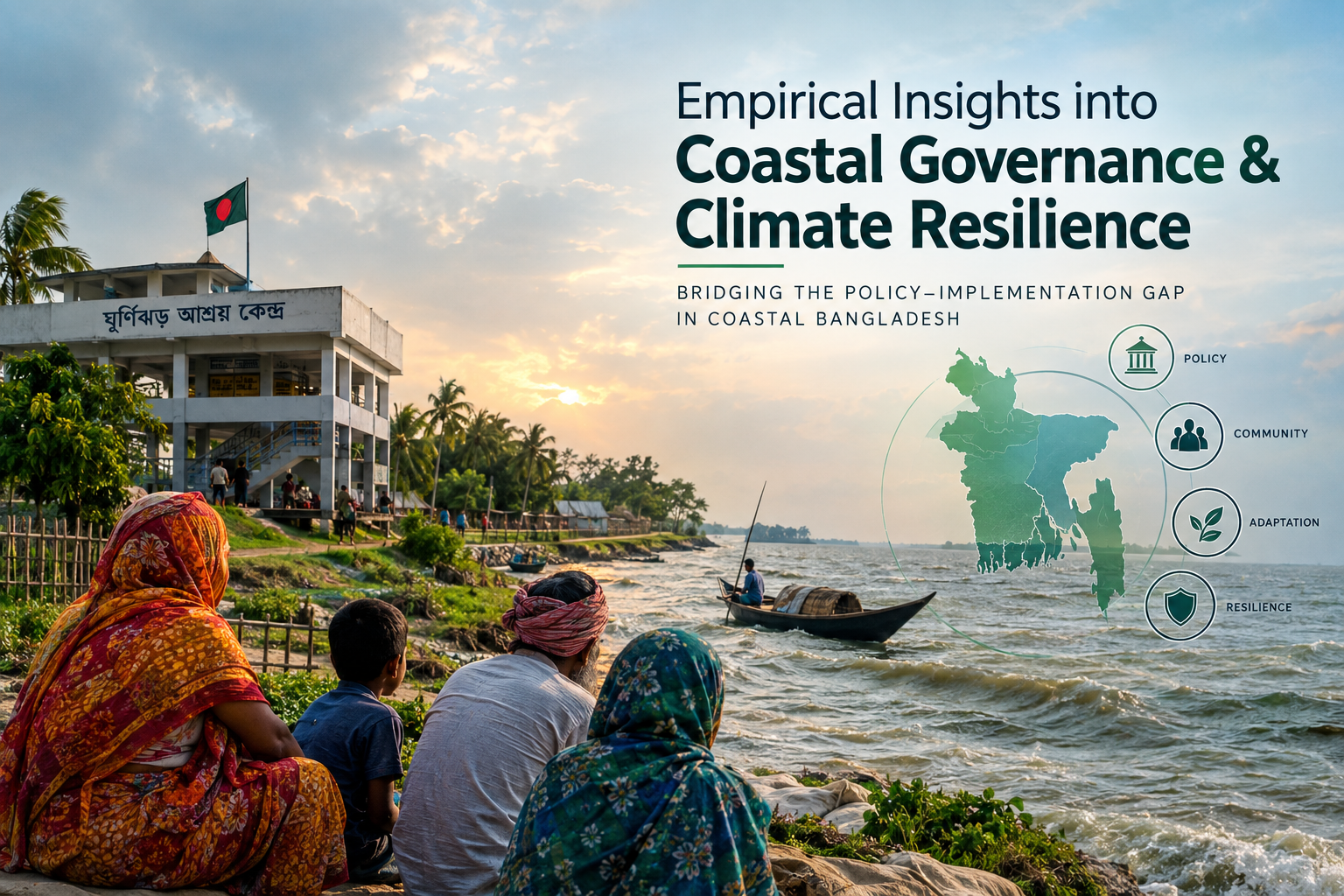
Bangladesh is often presented as a global symbol of climate vulnerability. Its low-lying deltaic geography, dense population, exposure to cyclones and storm surges, riverbank erosion, salinity intrusion and waterlogging make its coastal regions particularly vulnerable to a changing climate. Yet vulnerability alone does not explain why some communities are better able to withstand and recover from climate-related shocks than others. The more difficult question is one of governance: how effectively are national climate policies translated into meaningful action at the local level?
Bangladesh has made considerable progress in disaster risk reduction and climate adaptation. The country has developed national strategies and institutions, invested in cyclone preparedness, constructed shelters and embankments, and incorporated adaptation into long-term planning. The National Adaptation Plan (NAP) 2023–2050 represents another major attempt to establish a long-term framework for climate adaptation. However, policy formulation and policy implementation are not the same thing.
For coastal communities, resilience is ultimately experienced locally. A national adaptation strategy may identify salinity, flooding, displacement or livelihood insecurity as major risks, but households experience these problems through contaminated water, declining agricultural productivity, damaged homes, lost income and limited access to public services. This creates a critical governance question: what happens between the formulation of a policy in Dhaka and its implementation in a coastal village?
The policy–implementation gap
Empirical research increasingly suggests that this gap is one of the central challenges facing coastal resilience in Bangladesh. A study of coastal communities examining disaster-risk-reduction governance found that Bangladesh has made significant progress in developing disaster-management policies, but local implementation remains constrained by inadequate resources, corruption, political favoritism, limited accountability and insufficient participation in decision-making.
This distinction between policy ambition and institutional reality matters. A policy can be technically sophisticated while producing limited benefits if local institutions lack the authority, resources or accountability mechanisms necessary to implement it.
Research based on Bangladesh's DECCMA project provides particularly strong empirical evidence. Using 1,384 survey respondents, 19 focus-group discussions, 43 key-informant interviews and three workshops, researchers found that government adaptation interventions frequently followed what they described as a Reactive Approach of Limited Action (RALA)—a predominantly top-down response to climate-related events. The researchers argue instead for a Proactive Approach to Adaptation (PATA) in which local communities participate meaningfully in adaptation planning and implementation.
When participation becomes a governance issue
Community participation is frequently included in climate-policy language, but participation itself can mean very different things. Attending a consultation meeting is not equivalent to having influence over decisions. Being represented in a project does not necessarily mean having control over resources.
This distinction becomes particularly important in coastal Bangladesh, where socioeconomic inequalities influence who benefits from adaptation interventions.
Recent research from Koyra and Shyamnagar provides an illustration. A 2026 study examining NGO-led adaptation programmes through an intersectional lens found that women and persons with disabilities were significantly underrepresented in adaptation programmes. Only 27 percent of surveyed respondents believed NGOs prioritized disadvantaged groups, while 48.3 percent disagreed. Qualitative evidence also identified concerns around political interference, favoritism and tokenistic inclusion.
These findings challenge a common assumption that community-based adaptation is automatically inclusive. Local does not necessarily mean equitable. Local institutions can reproduce existing inequalities just as national institutions can.
Coastal governance must ask not simply whether communities participate, but who participates, whose knowledge counts, who controls resources, and whose interests shape adaptation priorities.
From infrastructure to institutional resilience
Bangladesh's success in reducing cyclone mortality demonstrates that institutions can make an enormous difference. The Cyclone Preparedness Programme, for example, has developed a large community-based volunteer network and has become an important component of disaster preparedness. The World Bank identifies community participation, local institutions, livelihoods adaptation and risk-sensitive planning as important components of long-term coastal resilience.
But resilience cannot be reduced to physical infrastructure.
Cyclone shelters, embankments, roads and communication systems are essential, yet their effectiveness depends on governance arrangements surrounding them. Who maintains infrastructure? Who receives assistance after a disaster? Which villages receive adaptation investments? Are marginalized households able to access shelters, credit or livelihood programmes? What happens when an embankment fails?
A micro-level study of planned adaptation in coastal Bangladesh found that interventions that appear effective at a regional scale may perform differently at the community level. The researchers identified accessibility and adequacy as important barriers and concluded that local perceptions need to be incorporated into adaptation implementation.
Knowledge must move in both directions
Another important governance problem is the flow of knowledge. Adaptation policy often assumes that expertise moves downward—from national agencies and technical specialists to local communities. Yet coastal residents possess forms of environmental knowledge developed through repeated experience with cyclones, salinity, waterlogging, erosion and changing agricultural conditions.
Research on adaptive governance in coastal Bangladesh shows that community resilience can be strengthened when local, regional and national institutions engage in collaborative learning. The study identifies nested institutional structures, social learning across governance levels and systematic documentation of lessons from disasters as important prerequisites for resilience. It also highlights the role of intermediary or “bridging” organizations in transferring local lessons into broader policy processes.
This points toward a different conception of governance. Instead of treating communities as passive recipients of adaptation, governments should treat them as knowledge-producing political actors.
Toward a more accountable coastal governance system
If the policy–implementation gap is a major obstacle, closing it requires more than another policy document. Bangladesh needs stronger institutional mechanisms connecting national adaptation priorities with local decision-making.
First, local governments require adequate financial and technical capacity to implement adaptation programmes rather than functioning primarily as administrative extensions of central government.
Second, participation needs to become substantive. Women, persons with disabilities, small farmers, fishers, landless households and other marginalized groups should have meaningful influence over adaptation priorities and resource allocation.
Third, adaptation programmes require stronger transparency and monitoring. Success should not be measured simply by the number of people attending meetings or projects completed. Evaluation should examine whether adaptation actually improves livelihood security, access to water, institutional trust and the ability of vulnerable households to recover from shocks.
Finally, Bangladesh needs stronger mechanisms for policy learning. Every cyclone, flood, embankment failure or adaptation project generates valuable evidence. That evidence should systematically travel from villages to local government, from local government to national institutions, and from national institutions back into future programmes.
Conclusion
The central challenge for coastal Bangladesh is no longer simply whether the country has climate policies. It is whether those policies can be translated into equitable, accountable and locally meaningful action.
The empirical evidence suggests that Bangladesh's resilience is strongest when institutions cooperate across levels, communities participate meaningfully, local knowledge is recognized and adaptation programmes are responsive to actual socioeconomic conditions. Conversely, political favoritism, weak accountability, institutional fragmentation and limited local decision-making can undermine even well-designed policies.
Coastal resilience, therefore, should be understood as a governance outcome.
The future of Bangladesh's coastal regions will certainly depend on embankments, cyclone shelters, freshwater infrastructure, climate-smart agriculture and other technical interventions. But it will depend just as much on the institutions deciding where those interventions go, who receives their benefits, who is excluded, and whether local communities have a genuine voice in shaping their own future.
The most important shift may therefore be conceptual: from asking “How can Bangladesh protect coastal communities from climate change?” to asking “How can Bangladesh build governance institutions capable of enabling coastal communities to shape their own resilience?”
That is where the policy–implementation gap becomes not merely an administrative problem, but a question of power, participation and political accountability.
Further Reading
- Alam, E., & Dominey-Howes, D. (2020). Good governance and local level policy implementation for disaster-risk-reduction: actual, perceptual and contested perspectives in coastal communities in Bangladesh. Disaster Prevention and Management.
- A governance perspective for climate change adaptation: Conceptualizing the policy-community interface in Bangladesh (2022). Environmental Science & Policy. Particularly useful for understanding the RALA–PATA distinction and the policy–community interface.
- Adaptive governance and community resilience to cyclones in coastal Bangladesh (2021). Environmental Science & Policy. Useful for understanding institutional collaboration, social learning and multilevel governance.
- Strengthening climate resilience in coastal Bangladesh: Analyzing the role of NGOs in adaptation governance from an intersectionality lens (2026). Progress in Disaster Science. Particularly relevant to questions of inequality, gender, disability, political interference and inclusion.
- National Adaptation Plan of Bangladesh 2023–2050. Government of Bangladesh. The principal national policy framework for understanding Bangladesh's long-term adaptation ambitions.
- World Bank — Coastal Resilience in Bangladesh. Useful for understanding Bangladesh's disaster-risk-reduction achievements, community participation and the relationship between infrastructure and institutional resilience.