Bangladesh at the Crossroads: Geopolitics, National Interest, and Strategic Autonomy in the India–China Rivalry
Introduction: A New Strategic Era for Bangladesh
For many years, Bangladesh was mostly discussed in terms of poverty, development aid, and climate vulnerability. That image is now outdated. Over the last five decades, the country has transformed into a significant economic and strategic actor in South Asia, with a growing industrial base, an important role in global supply chains, and a critical location on the Bay of Bengal.
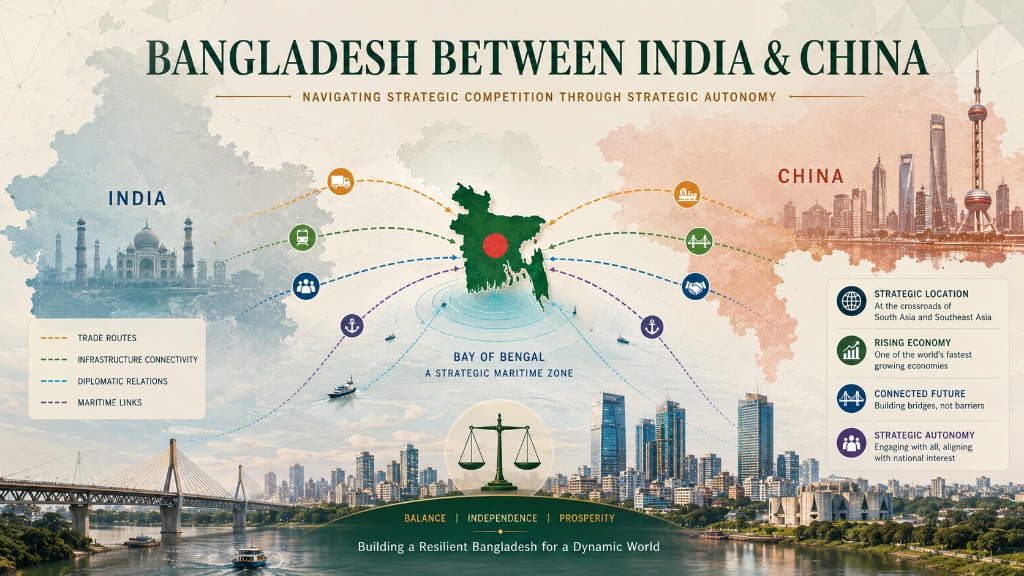
Bangladesh now sits at the intersection of South Asia, Southeast Asia, and the wider Indo-Pacific. It shares a long border with India, has deepening economic and strategic ties with China, and maintains important relationships with the United States, the European Union, Japan, and other partners. As global and regional competition intensifies, especially between India and China and in the broader US-China rivalry, Bangladesh faces a fundamental question:
The question is not “Should Bangladesh choose India or China?” The real question is: “How can Bangladesh use its strategic position to strengthen its own national capabilities and pursue an independent foreign policy?”
This article argues that Bangladesh’s future foreign policy should be guided by strategic autonomy: engaging constructively with multiple partners while ensuring that every major relationship serves Bangladesh's long-term national interest.
1. Why Bangladesh Matters Today
From development challenge to strategic actor
At independence in 1971, Bangladesh emerged from a devastating war with a shattered economy and weak institutions. Over time, however, it achieved notable progress in economic growth and poverty reduction, industrial expansion and export growth, human development, and contributions to UN peacekeeping and international diplomacy.
The ready-made garment industry played a central role, moving Bangladesh from aid dependency to becoming one of the world’s leading apparel exporters. Economic success has translated into greater diplomatic relevance and strategic visibility.
Geography as a strategic asset
Bangladesh’s importance cannot be understood without geography. Located between India and Myanmar on the Bay of Bengal, it sits at a crucial junction between South Asia and Southeast Asia. This position offers access to key maritime trade routes, potential to serve as a connectivity hub between regions, and importance for Bay of Bengal security and the broader Indo-Pacific.
As the Indo-Pacific concept gains prominence in global strategy, Bangladesh’s location places it squarely within a region defined by trade routes, energy flows, maritime security, and great-power competition. Yet Bangladesh’s role must be defined by its own interests: expanding trade, developing maritime resources, attracting investment, improving connectivity, and strengthening economic resilience.
2. From Survival Diplomacy to Strategic Engagement
Early foreign policy: recognition and survival
After 1971, Bangladesh’s foreign policy focused on gaining international recognition, securing aid and rebuilding a war-torn economy, establishing diplomatic relations, and protecting sovereignty. The famous principle “Friendship to all, malice toward none” captured a desire to maintain constructive relations with all countries while avoiding entanglement in great power conflicts.
During the Cold War, Bangladesh navigated a divided world-US-Pakistan ties, Soviet-India alignment, and China’s growing regional role by seeking flexibility rather than rigid bloc alignment. The basic pattern was clear: engagement with multiple partners was necessary to protect national interests.
Regional cooperation and economic diplomacy
As its position stabilized, Bangladesh embraced regional cooperation, playing a key role in creating SAARC in 1985. It recognized that poverty, trade barriers, environmental risks, and security challenges could not be addressed by any single state alone.
With globalization, foreign policy shifted from aid and recognition to economic diplomacy. Access to Western markets for garments strengthened Bangladesh’s economy and showed that for developing countries, economic capability is closely linked to diplomatic influence.
Middle power ambitions
Bangladesh today participates in peacekeeping, climate diplomacy, development debates, connectivity initiatives, and multilateral institutions. Some analysts describe it as an emerging middle power due to its large population, economic growth, and strategic location.
To become a credible middle power, however, Bangladesh needs strong institutions, consistent policies, strategic planning, and knowledge based diplomacy. The new challenge is no longer just survival, but how to benefit from partnerships while protecting strategic independence.
3. India’s Strategic Interests in Bangladesh
India-Bangladesh relations are among the most complex in South Asia. They are shaped by shared history, geography, culture, and economic links but also by asymmetry and competing national interests.
Geography and connectivity
Bangladesh is surrounded by India on three sides, sharing over 4,000 km of border. It is crucial for India’s eastern security and for connectivity to its northeastern states, which are bottlenecked through the narrow Siliguri Corridor (“Chicken’s Neck”).
A cooperative Bangladesh offers India better transport routes to the northeast, expanded trade and regional integration, and easier security management in the eastern frontier. For Bangladesh, connectivity with India can mean transit revenue, infrastructure development, and deeper regional integration if projects are designed with mutual benefit and respect for sovereignty.
Security, economy, and water
India’s interests also include border security, counterterrorism, and managing cross-border crime and irregular migration. Security cooperation has expanded over time and can benefit both sides when conducted transparently and on an equal basis.
Economically, India is a major trading partner. Bangladesh imports machinery, industrial inputs, and various goods from India, but faces concerns over trade imbalance and market access. A sustainable relationship requires meaningful benefits on both sides, including better opportunities for Bangladeshi exports.
Water politics remains sensitive. Shared rivers and joint management of water resources are vital for agriculture, ecology, and livelihoods. Agreements such as the Ganges Water Sharing Treaty (1996) show cooperation is possible, but unresolved water issues still shape public perceptions and trust.
Asymmetry and strategic balance
India is larger in territory, population, economy, and military capacity. This asymmetry defines the relationship. For Bangladesh, the goal should not be confrontation or dependence, but a balanced approach: cooperate where interests align, negotiate differences through diplomacy, protect sovereignty and national priorities, and maintain strategic flexibility.
India’s broader regional strategy and its concerns about China’s growing presence in South Asia also influence how it views Bangladesh. But Bangladesh’s foreign policy must be shaped by its own national interest, not solely by India-China competition.
4. China’s Strategic Interests in Bangladesh
China’s rise has reshaped Asian geopolitics, and Bangladesh-China ties have expanded rapidly since diplomatic relations began in 1975.
Economic partnership and infrastructure
China is now a major source of industrial machinery, manufacturing inputs, electronics, consumer goods, and infrastructure financing. Bangladesh’s industrial growth, especially garments, has benefited from Chinese supply chains, though imports from China far exceed exports. This underscores the need for Bangladesh to strengthen its own export capacity and move into higher value industries.
China’s financing of roads, bridges, ports, power plants, and industrial zones supports Bangladesh’s infrastructure needs. At the same time, large projects must be evaluated for financial sustainability, transparency, local capacity building, and long-term economic returns.
Bangladesh joined the Belt and Road Initiative (BRI) in 2016, integrating its development plans with China’s broader connectivity vision. The key question is whether BRI projects genuinely serve Bangladesh’s development priorities.
Defence and the Bay of Bengal
China is an important defence partner for Bangladesh, supplying equipment and technical support. This can help diversify suppliers and avoid overdependence on any single country, provided defence modernization remains aligned with national security needs.
The Bay of Bengal is central to China’s maritime interests and to Bangladesh’s own blue economy ambitions. Cooperation in maritime trade, port development, and marine resources must be guided by Bangladesh’s sovereignty and long-term interests.
China–India competition and Bangladesh’s choice
China’s expanding role in South Asia is closely watched by India and other powers. Bangladesh, positioned between these rivals, is often framed as a potential “choice” between India and China. That frame is misleading.
Bangladesh can cooperate with China on infrastructure and industry, work with India on connectivity and regional security, and maintain trade and development ties with Western partners. This is not a zero-sum game if Bangladesh designs its foreign policy based on strategic autonomy, not external pressures.
5. Bangladesh’s National Interest in a Changing World
Foreign policy is ultimately a tool to advance national interest. For Bangladesh, defining that interest clearly is essential in an era of great-power competition.
Theoretical lenses
Different international relations theories highlight different aspects of national interest: realism focuses on security, power, and survival; liberalism stresses economic cooperation and institutions; constructivism emphasizes identity, values, and historical experience.
Bangladesh’s reality requires a combination of these: security and sovereignty, economic development, cooperative diplomacy, and a strong sense of national identity.
Core pillars of national interest
Bangladesh’s national interest can be understood through several pillars:
- Sovereignty and strategic independence - territorial integrity, independent decision-making, control over resources, and freedom from excessive external dependency.
- Comprehensive security - defence and territorial security, maritime security, border management, cybersecurity, energy security, economic stability, and climate resilience.
- Economic transformation - moving beyond narrow reliance on garments toward diversified industries such as pharmaceuticals, technology, advanced manufacturing, renewable energy, and knowledge based services.
- Energy and resource security - diversified and sustainable energy sources, regional cooperation, and efficient resource management.
- Climate security - adapting to sea-level rise, erosion, extreme weather, and climate-induced migration while using climate diplomacy to secure international support and shape global debates.
- Regional influence and global standing - leveraging peacekeeping, climate leadership, and development experience to gain voice in regional and global forums.
These pillars highlight that Bangladesh’s national interest is broader than traditional military security. It includes economic resilience, environmental sustainability, technology, and international influence.
6. The Bangladesh Strategic Autonomy Framework (BSAF)
To navigate great-power competition, Bangladesh needs a coherent framework that links foreign policy to national development. This article proposes the Bangladesh Strategic Autonomy Framework (BSAF), built on five pillars:
- Sovereign decision-making
- Economic resilience
- Diversified strategic partnerships
- National capability development
- Strategic pragmatism
Strategic autonomy explained
Strategic autonomy does not mean isolation or neutrality. It means engaging with multiple partners, avoiding dependency on any single power, and preserving freedom of action in foreign policy.
Economic resilience through diversification, technology, and innovation gives Bangladesh bargaining power. Diversified partnerships with India, China, Western countries, Japan, and others widen strategic options.
National capability development is equally critical: strong institutions, educated citizens, research capacity, and credible security forces enable Bangladesh to negotiate and implement policies effectively.
Strategic pragmatism means focusing on outcomes rather than emotions or slogans. Bangladesh should evaluate each partnership by asking whether an agreement strengthens the economy and technology, protects or expands sovereignty, and builds long-term national capacity.
Under BSAF, the India-China question is reframed. Bangladesh does not have to “choose” between them. It has to choose which specific forms of cooperation serve Bangladesh’s interest.
7. Policy Recommendations for a More Strategic Foreign Policy
To turn strategic autonomy from concept into practice, Bangladesh should pursue several policy priorities:
- Interest based foreign policy - judge all partnerships against clear national interests rather than ideology or personal relationships.
- Strong economic diplomacy - diversify exports, attract investment that brings technology transfer and skills, and expand market access.
- Balanced connectivity strategy - design connectivity projects that benefit Bangladesh, strengthen domestic infrastructure, and remain transparent and sustainable.
- Institutional capacity-building - develop think tanks, university research centres, and specialized institutes; professionalize the foreign service; and improve coordination.
- Modern, balanced defence and security policy - focus on maritime security, cybersecurity, border management, and disaster response; recognize economic and climate vulnerabilities as security issues.
- Maritime strategy and blue economy - turn the Bay of Bengal into a source of sustainable growth through marine research, fisheries, shipping, and offshore energy.
- Climate diplomacy as a strategic tool - lead global discussions on climate finance, adaptation, and loss and damage, using Bangladesh’s experience.
- Strategic balance among major powers - maintain cooperative but independent relationships with India, China, Western partners, Japan, and others.
- National strategic culture - invest in international relations education, policy research, and informed public debate.
- Long-term strategy beyond political cycles - design foreign policy and major strategies with horizons beyond immediate elections and leadership changes.
8. Conclusion: Toward a Confident Bangladesh
Bangladesh has travelled a remarkable path from a war ravaged, aid-dependent country to an emerging strategic actor in South Asia and the Indo-Pacific. Its future will be shaped by how it uses this new importance.
Bangladesh should not see itself merely as a field where others compete, nor as a passive recipient of external decisions. It must act as a country with its own clear national interests and strategic vision.
A confident Bangladesh will cooperate widely without becoming dependent, engage with major powers without losing sovereignty, pursue development without compromising strategic interests, and participate in global affairs with an independent voice.
The core argument of this article is simple: Bangladesh’s strategic future depends on building the capacity to navigate great-power competition through strategic autonomy.
Geography and economic growth have given Bangladesh opportunity. Only strong institutions, informed strategy, and national capability can turn that opportunity into lasting influence.
Strategic autonomy is not the absence of partnerships. It is the ability to choose partnerships wisely.
Further Reading
For readers interested in the theoretical and strategic background of this article, the following works and institutions offer useful perspectives:
- John J. Mearsheimer, The Tragedy of Great Power Politics - on how states pursue security and power in a competitive international system.
- Kenneth N. Waltz, Theory of International Politics - on how international structures shape state behaviour.
- Amitav Acharya, The End of American World Order - on multipolarity and the changing global order.
- Robert D. Kaplan, Monsoon: The Indian Ocean and the Battle for the Twenty-First Century - on the strategic importance of the Indian Ocean and Bay of Bengal.